


AFRIKA Awards

Updated: Jul 25
One of the things I love most about my work is that it consistently brings me into contact with people who care deeply about what they do.
Whether they work in science, education, healthcare, technology, community organizing, or the arts, I am fortunate to spend my days listening to people who are passionate about their mission and committed to making a positive impact on the world.
My role is often simple: listen, observe, and translate conversations into visual stories through live illustration.
Most of the time, those conversations are interesting.
Many are inspiring.
But every now and then, I am invited into a conversation that stays with me long after it is over.


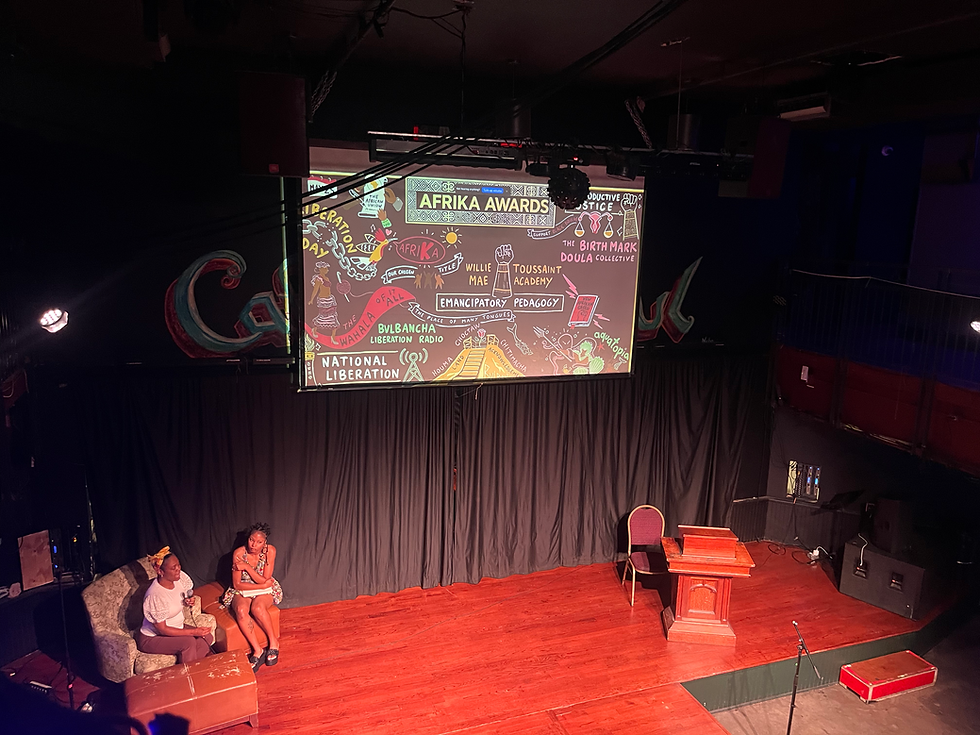
Recently, I had the opportunity to support the inaugural AFRIKA Awards in New Orleans. Unlike many of the events I illustrate, I wasn't physically present. I joined remotely through Zoom, listening from hundreds of miles away while creating live visual notes in real time.
And yet, despite the distance, I could feel the energy.
I could hear it in the voices of the speakers.
I could hear it in the applause.
I could hear it in the stories being shared.
This was not one of the giant corporate events that often dominate the conference industry. There were no celebrity keynote speakers. No massive productions. No extravagant budgets.
In fact, events like this are often built with far fewer resources than the large conferences many of us are accustomed to seeing.
What made this gathering significant was something entirely different.
It was about justice.
In life, we all organize our priorities differently. For some, family comes first. For others, career, financial success, achievement, or personal ambition. There is nothing wrong with any of those things.
But there are people who dedicate their lives to something larger than themselves.
They devote their work to addressing injustices that have existed for generations. They recognize that history does not simply disappear because time passes. The effects of discrimination, exclusion, and inequity continue to shape people's lives today, sometimes openly and sometimes in ways that are much harder to see.
For underserved communities, for women, and for Black communities in particular, the pursuit of justice is not an abstract conversation about the past. It is an ongoing reality.
As a white man living in America, I am aware that many opportunities and assumptions afforded to me are not experienced equally by everyone. The ability to move through the world without certain barriers, fears, or prejudgments is not universal.
Every human being deserves dignity.
Every human being deserves the opportunity to believe in themselves, pursue their ambitions, and build a meaningful life without being limited by prejudice or discrimination.
Yet these challenges remain with us.
History does not erase itself.
We must continue to learn. We must continue to listen. We must continue to create opportunities for healing and understanding.
That is why the AFRIKA Awards felt so important.
Held in celebration of Africa Liberation Day, the inaugural AFRIKA Awards recognized organizations and individuals whose work advances liberation, justice, education, and self-determination. Throughout the event, I listened to stories and perspectives that were thoughtful, moving, and deeply inspiring.
The Birthmark Doula Collective, recipient of the Afrika Award for Reproductive Justice, shared their commitment to supporting Black birthing families and improving maternal health outcomes throughout Louisiana. Their work reminded everyone listening that healthcare, dignity, and reproductive autonomy are inseparable from justice itself.
One of the most captivating moments of the event was Aquatopia, a performance by the Culu/N'Kafu Traditional Afrikan Dance Company inspired by the Afrofuturist mythology of Drexciya. Reimagining the tragic history of enslaved Africans lost during the Maafa, the performance envisioned an underwater civilization born from resilience, survival, and liberation. Even through a screen, the movement, music, and storytelling were mesmerizing. It was a beautiful example of how art can transform historical trauma into imagination, possibility, and hope.
The National Liberation Award was presented to Bvlbancha Liberation Radio, a community radio station amplifying Indigenous voices, stories, music, and perspectives throughout the Gulf South. Their conversation served as a reminder that liberation movements are interconnected and that communities must retain the power to tell their own stories and preserve their own histories.
Another unforgettable moment was The Wahala of It All, a fashion show by crochet fiber artist Dartanya Croff. More than a fashion show, it was a wearable archive and a love letter to Mother Afrika. Through handcrafted crochet garments, Croff explored African history, cultural memory, spirituality, and identity. Each piece functioned as a chapter in what she describes as A Crochet Wearable Archive of Africa's Stolen Wealth, transforming fiber art into an act of preservation and education.
The Afrika Award for Emancipatory Pedagogy was presented to Nicole Adams and the Willie Mae Toussaint Academy. Their work centers on the belief that education should empower students to understand themselves, their communities, and their history. At a time when debates about education and historical truth continue across the country, their commitment to emancipatory learning felt especially meaningful.
What stayed with me most, however, was not any single award or performance.
It was the collective spirit of the event.
There was music.
There was storytelling.
There was art.
There was joy.
And there was a profound sense of purpose.
Even from behind a computer screen, I could feel the energy of a community gathered not simply to celebrate achievements, but to honor the ongoing work of liberation, education, healing, and cultural preservation.
As someone whose role is usually to document conversations, I finished the event feeling grateful.
Grateful for the opportunity to listen.
Grateful for the trust placed in me to visually capture these stories.
Grateful for the people dedicating their lives to work that often receives far less attention than it deserves.
The irony is that I was never actually in the room.
Yet by the end of the day, it felt like I had been.
That is the power of meaningful conversations.
That is the power of storytelling.
And that is the power of communities working toward a more just future.
Thank you to everyone who made the inaugural AFRIKA Awards possible.
Thank you for trusting me to help document your gathering through live illustration.
It was an honor to contribute, even from afar, and to help elevate voices that deserve to be heard.
Some events are professionally rewarding.
Others are personally meaningful.
This was both.


Comments